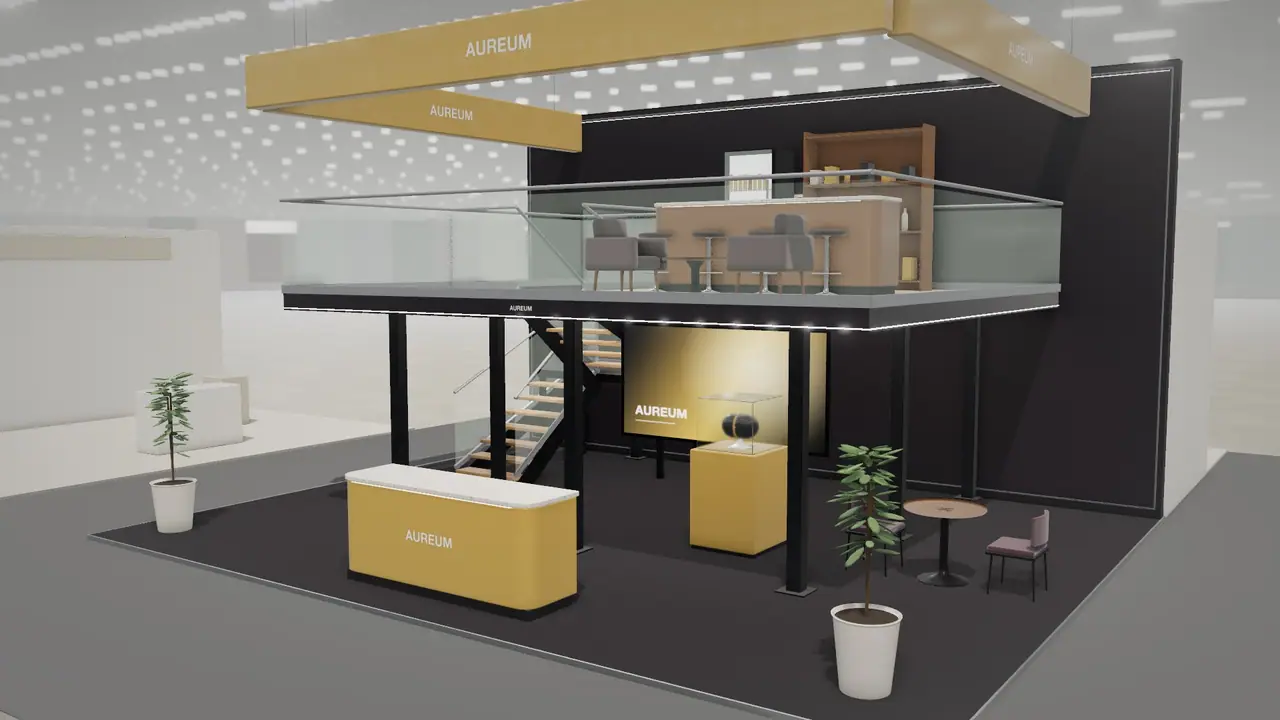
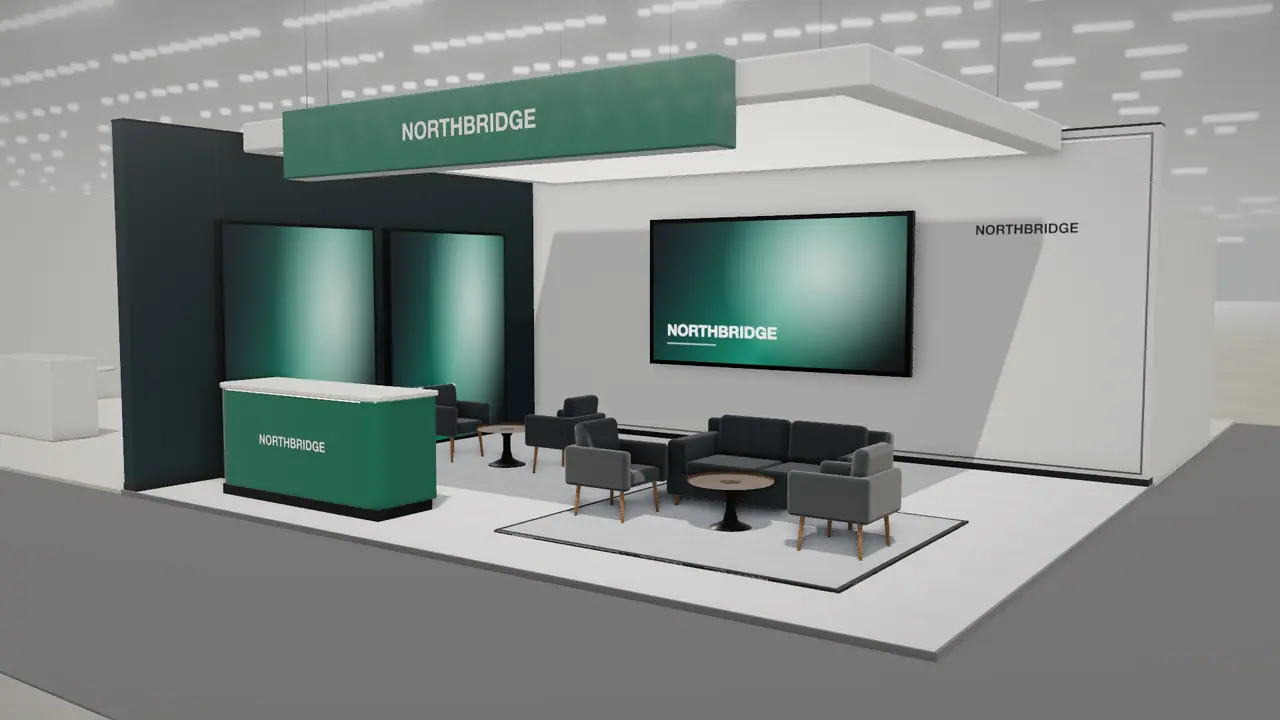
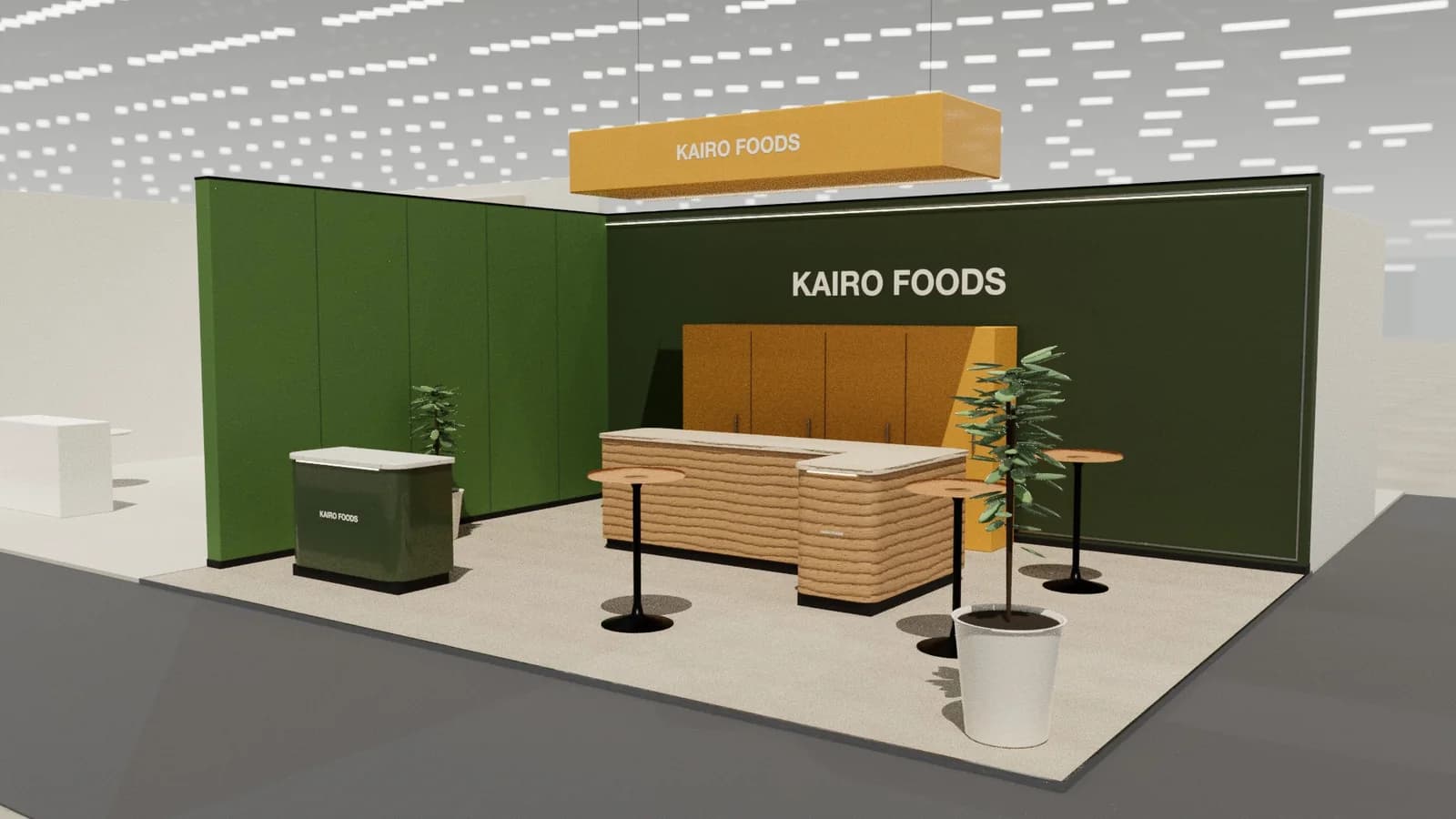
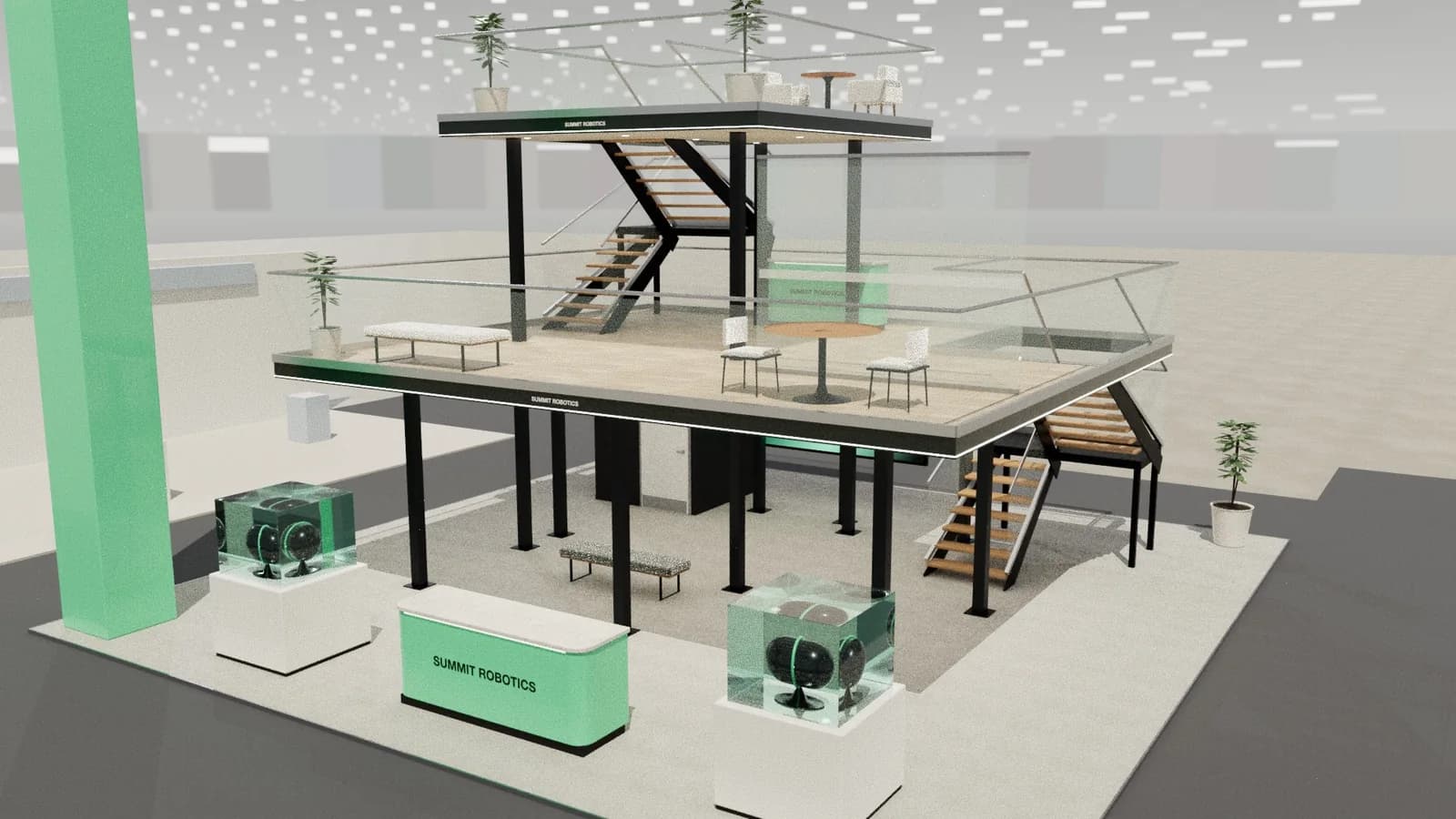
In short
Curved stands stand out because most of a hall is built from straight lines. A curve can draw people in, frame a product and give the stand a recognisable shape from across the aisle. Use one confident gesture, such as a sweeping wall, a ribbon ceiling or a ring overhead, rather than rounding everything. Keep the plan simple, and let the curve guide visitors towards the thing you want them to see.
Key points
- One big curve beats many small ones.
- Curves steer people, so draw the route first.
- Curved walls cost more in making, finishing and transport.
- Graphics and lighting must be measured along the arc.
Eight curved ideas
- The sweep: one long wall arcs across the back of the plot and carries the brand. It suits a row stand that wants more presence than a flat wall.
- The ribbon: a continuous band rises from a wall and runs overhead, joining floor and ceiling in one line.
- The halo: a ring hangs above the stand and marks it from a distance, with the floor kept open below.
- The nook: a tight curve wraps a lounge, creating calm inside a noisy hall.
- The wave: a rippling wall of battens or fins brings movement to a long frontage.
- The orbit: counters and plinths follow a circle around a hero product.
- The canyon: two curved walls create a route between them, leading to a reveal.
- The lantern: a glowing cylinder of fabric acts as a meeting room or a beacon.
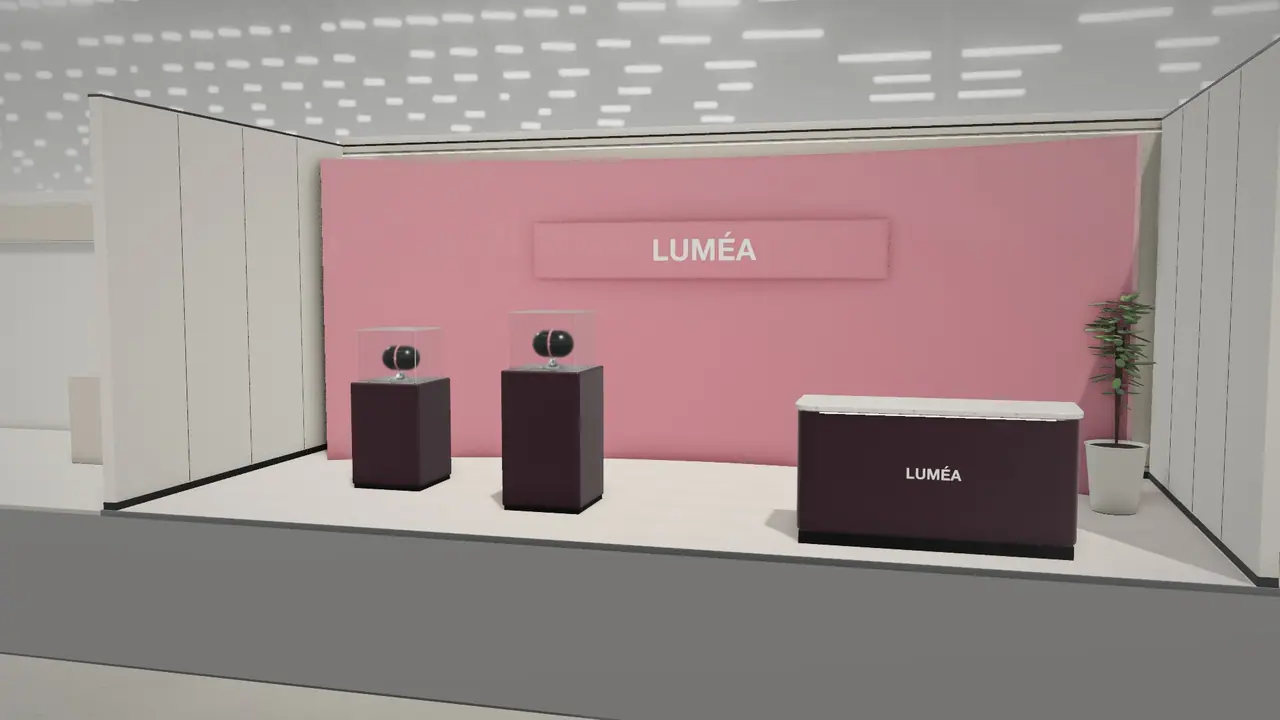
Curves change how people move
A concave wall gathers people, like a small amphitheatre. A convex wall pushes them around it. Straight aisles direct visitors past a stand, so a curve at the entrance can turn that movement inward. Before you choose a shape, draw the way you want a visitor to travel and put the curve along that line. Our traffic flow guide explains the basics.
Curves also change usable floor. A wall following a plot corner leaves dead corners behind it. Use them for storage, a coffee point or cable routes, because they are otherwise wasted.
What suits each plot
| Stand type | Curve that works | Watch for |
|---|---|---|
| Row | A sweep along the back wall | Depth: a deep curve eats visitor floor |
| Corner | A curve that wraps the closed corner | Leave both aisle edges open |
| Peninsula | A horseshoe of walls open to the aisle | Plan back-of-house behind the curve |
| Island | A central drum, or a ring overhead | Every side needs a front |
What drives the cost
A curved wall usually costs more than a straight one of the same plan width, for four reasons: it is longer, because the arc exceeds the chord; it needs ribs, formers or bent frames; finishing takes more labour; and it has to be cut into sections to travel. Tension fabric on a formed frame is often the lightest way to do it. Use the curved wall calculator for the radius and arc, then read how curved walls are built.
Graphics and lighting on curves
- Long type on a tight curve wraps out of view. Keep the logo where the wall faces the aisle.
- Faces and product photos distort when seen at an angle, so test them in 3D.
- LED strip along the top or base of a curve is the cheapest way to draw the shape in light.
- Spotlights make scallops on a curved wall. Use a wall washer or an even backlight.
Frequently asked questions
01Are curved exhibition stands more expensive?
Generally yes, because of extra length, shaped framing, finishing and transport. Fabric on formed frames or a single curved feature can keep it contained.
02Can a small stand have curves?
Yes, if the curve is modest. A curved counter or a gentle back wall works on a 3 × 3 m stand. A deep curve would eat too much floor.
03Do curved stands work with modular systems?
Many systems include curved profiles at fixed radii, and fabric covers them neatly. Ask your supplier which radii they stock.
04Can AI design a curved stand?
Yes. Studio composes curved stands in 3D at your plot size, which you can then edit and export as drawings. Your builder still checks how to make it.
Put it into practice
An AI booth designer that designs in 3D, not in pixels
An AI booth designer that plans an exhibition stand in 3D at your size, checks it can be built, and changes it when you ask in plain English.
Guidance here reflects common practice. Venues, organisers and countries set their own rules: always check the exhibitor manual and work with a qualified stand builder and engineer for structures.